What is boom cylinder mounting, and why it reads faster than counterweight shape
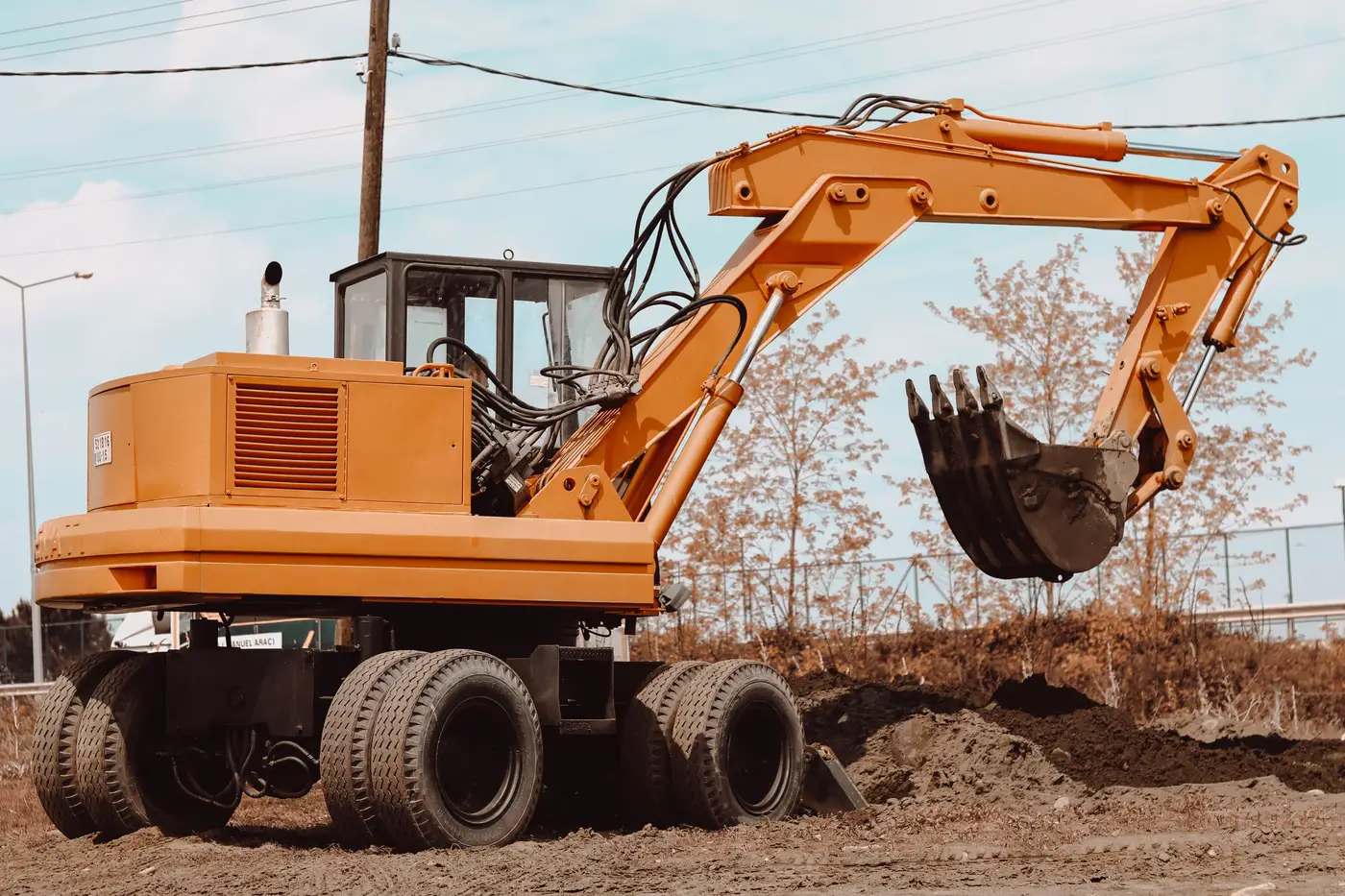
A boom cylinder tells you who built the machine before you've even gotten to the counterweight. Cylinder mounting is a structural decision an OEM makes once, early in a model's development, and rarely revisits. Counterweight shape gets restyled every few years for cosmetic or regulatory reasons. One signature is stable. The other moves. If you spend enough time cross-referencing site imagery against spec sheets, that difference is why cylinder mounting is the faster tell.
What boom cylinder mounting actually means
The boom cylinder is the ram that lifts the boom off the ground, anchored at one end to the upper structure and at the other to the boom foot. Every excavator has a cylinder there. What varies by manufacturer is how it's mounted: single cylinder centered on the boom's vertical plane versus a pair flanking it, the angle of the clevis relative to the boom's pivot pin, how far forward the trunnion sits on the upper frame, and whether the mounting lug is a cast boss or a welded bracket.
Those choices show up as repeatable geometry in profile-view imagery. A single-cylinder boom casts one shadow line down the centerline. A dual-cylinder boom casts two, symmetric and visibly offset from center. The angle at which the cylinder meets the boom foot, shallow or steep, holds across a manufacturer's whole excavator range because it's tied to boom casting tooling that doesn't get re-engineered for a facelift.
Why it beats counterweight shape as a read
Counterweight silhouette is a good cue and worth tracking. It has a shelf life problem, though. A manufacturer can reshape a counterweight for a new emissions tier, a styling refresh, or a regional variant, and the change ships inside two or three model years. Boom cylinder placement doesn't move on that schedule. It's load-path engineering, not sheet metal. Changing it means re-engineering the boom casting and the upper frame mounting points together, which is expensive enough that OEMs carry the same mounting geometry across a decade or more of models.
That durability matters for attribution work specifically. If you're trying to assign a brand to a machine detected in very-high-resolution imagery, you want a cue that won't drift between the imagery date and whatever reference set you're checking it against. Cylinder placement, boom foot angle and whether the boom is single or dual-ram give you that. Color helps when it's visible and unfaded. Counterweight shape helps when the model year is recent. Cylinder mounting holds up regardless of model year, which is why an analyst working off dated or resold-fleet imagery leans on it first.
Reading it off an aerial frame
In practice this means working from a top-down or oblique angle rather than a side profile, since that's what VHR imagery usually gives you. Cylinder mounting still shows up as a shadow pattern and a silhouette width at the boom foot from overhead, once you know what you're looking for relative to the boom's long axis. It's a harder read than a straight machine count. You're correlating a structural detail against a mental, or literal, reference library of who builds what, and that's a different skill than tallying units on a site.
That's the gap FlyPix is working on with Machine Brand Recognition, reading color, boom geometry and counterweight silhouette together from site imagery to attribute each detected machine to a manufacturer, instead of leaving that cross-referencing to an analyst doing it frame by frame.
If you're doing this kind of attribution by hand right now, it's worth seeing where an automated first pass could save you the frame-by-frame part.