Liebherr vs. Manitowoc crawler cranes: reading boom and counterweight from above
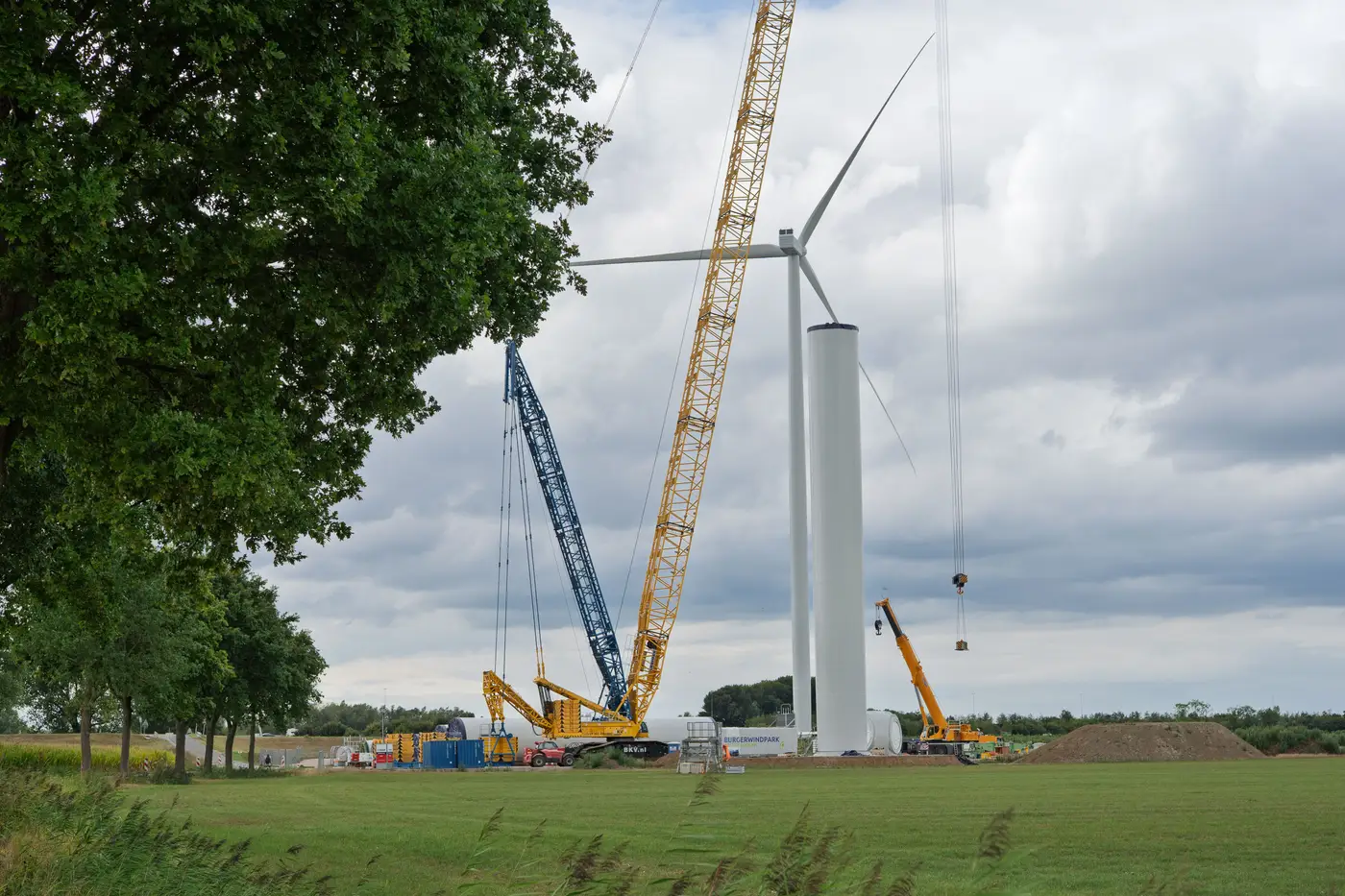
Paint fades, gets repainted, or gets lost entirely in a pan-sharpened image shot at a bad sun angle. If you're attributing crawler cranes to a manufacturer from overhead imagery, color is the last thing you should lean on. Boom geometry and counterweight arrangement hold up a lot better, and they're visible even on a crane that's been sitting on a jobsite long enough to go three shades of rust.
Counterweight position is the fastest tell
The single biggest overhead giveaway between these two OEMs isn't the boom. It's where the counterweight sits relative to the superstructure.
Liebherr's big lattice-boom crawlers (the LR and LTR lines) commonly run a Variable Position Counterweight, known in the trade as VPC. That's a counterweight tray mounted on its own set of wheels or a mini-crawler, trailing behind the main superstructure on a linkage rather than bolted directly to it. From directly overhead, this shows up as a distinct, separate rectangular footprint set a few meters back from the crane body, sometimes with a visible gap or connecting arm between the two shapes. On a big SX-class unit under load, that trailing block can look almost like a second, smaller vehicle parked behind the crane.
Manitowoc's MLC series, by contrast, stacks its counterweight directly on the superstructure or carbody, close in and boxy. Even with the Max-ER attachment, which does reposition weight out and away from the crane, the stacked blocks read as a tighter, more compact rectangle hugging the machine rather than a wheeled unit trailing behind it on its own track. If you're scanning a laydown yard and you see a crane with an oddly separate rear footprint connected by a thin linkage, put your money on Liebherr before you even look at the boom.
Boom chord and lattice pattern, second pass
Once counterweight has narrowed the field, the boom itself confirms or complicates the call.
Both manufacturers build four-chord lattice booms for their heavy crawlers, so chord count alone won't separate them. What differs is the bracing pattern and the boom foot. Liebherr's boom sections tend toward a narrower, more tapered lattice with tighter cross-bracing near the boom foot, and the pivot point sits lower and closer to the carbody. Manitowoc's MLC boom foot sits a bit higher off the deck, and the lattice bracing reads slightly wider and more open in the first few sections above the pin. On a very-high-resolution image where you can actually resolve individual bracing members rather than a blurred lattice silhouette, this difference is legible. On a lower-resolution capture where the boom reads as a single tapered line with a shadow, it isn't, and you're back to counterweight shape and job context to make the call.
One more thing worth flagging: telescopic boom cranes (most rough-terrain and all-terrain units, including smaller Liebherr and Manitowoc hydraulic cranes) don't have this problem at all. A telescopic boom reads as a solid tapered tube with no lattice texture, no bracing lines, nothing to cross-reference against a manufacturer's chord pattern. If you're trying to brand-ID a telescopic unit, boom shape won't help you much, and you're relying almost entirely on carbody proportions, cab shape, and whatever counterweight tray is visible.
None of this is a substitute for a serial number or a decal, obviously. It's what you've got when the imagery is all you've got, and the fleet you're counting isn't going to let you walk the yard with a notepad.
Why this matters for a fleet count
A raw crane count tells you a competitor has twelve crawlers on a mega-project site. A brand-attributed count tells you nine are Liebherr and three are Manitowoc, which is the number that matters if you're tracking OEM market share on infrastructure work rather than just tonnage on-site. Machine Brand Recognition is built around exactly that second read, pulling boom geometry and counterweight silhouette out of very-high-resolution imagery to turn a bare machine count into a per-manufacturer tally.
The Machine Brand Recognition pilot turns a raw crawler count into a per-manufacturer breakdown, worth a look if brand-level fleet share is the piece missing from your competitive tracking.